This is topic Projector Shutter Theory in forum 8mm Forum at 8mm Forum.
To visit this topic, use this URL:
https://8mmforum.film-tech.com/cgi-bin/ubb/ultimatebb.cgi?ubb=get_topic;f=1;t=009119
Posted by Zechariah Sporre (Member # 2358) on April 17, 2014, 07:36 PM:
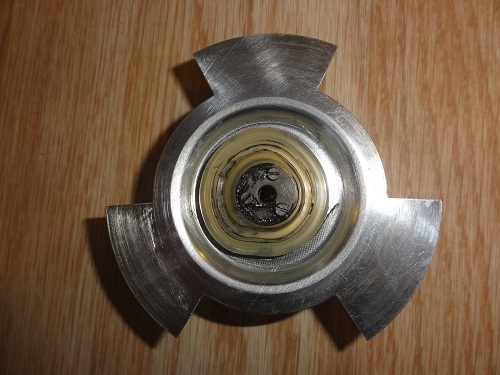
I was looking for help to understand shutter theory. I have been entertaining the idea of converting my Eumig 810D to a 2 blade shutter. As I was looking at mine it appears only the 1 of the 3 blades covers the gate as it switches frames so why do we need the other 2 blades? I know that it makes flicker if there wasn't but I don't understand why.
I have the shutter pulled out of my parts Eumig. Would you want to make a 2 blade shutter with the same width blade but just have 1 other blade directly across from the blade that covers the gate when it's switches frames?
Posted by Steve Klare (Member # 12) on April 17, 2014, 08:40 PM:
About a century ago someone established that at around 40 flashes of light per second, the human eye and brain stops seeing flashes and instead blends it together into a continuous beam of light.
If you were projecting at 50 FPS a single blade would do just fine. At 24 FPS you need two blades to get 48 flashes per second. Get down to 18 FPS with that two blade and you're still only up to about 36 flashes per second and just slightly flickery. This is where the three bladed shutter comes from, and why you lose 18FPS capability when you go to two blades.
You would want the second blade as you've descrbed it. If nothing else it would be rotationally balanced that way. Part of me suspects that if the two flashes alternated in brightness because the two openings weren't equal angles you might start to perceive a flicker again anyway.
Posted by Ken Finch (Member # 2768) on April 18, 2014, 02:45 PM:
Hi, My motto is, "If it aint broke don't mend it!" You will certainly get flickering if you only fit 2 blades and the picture would not be very noticeably brighter. Ken Finch.
Posted by Andrew Woodcock (Member # 3260) on April 18, 2014, 03:25 PM:
You have a good point there initially Ken, however to suggest that approximately 20% extra light output isn't noticeable is ludicrous, when of course it most certainly is! Flickering, as has been explained extremely well by Steve, is only really noticeable to most people at 18fps for exactly the scientific factual reasons that he gave. Therefore if you only use your machine for package movies and never for home movies, why not try to get the brightest image available from it?
[ April 19, 2014, 11:11 AM: Message edited by: Andrew Woodcock ]
Posted by Paul Adsett (Member # 25) on April 18, 2014, 09:48 PM:
I converted both my GS1200'S to 2 blade shutters. When I had converted just one of them, I did a side-by-side comparison. What I found was that the brightness of the 2 blade on LOW brightness setting was about the same as the brightness of the 3-blade on HIGH brightness setting! So the increase in brightness with the 2 blade on HIGH brightness was very noticeable indeed, and the screen was also much whiter and colors seemed much more vivid. So I would definately recommend conversion to 2 blade shutter, as long as you are not going to be using the projector at 18fps.
Posted by Zechariah Sporre (Member # 2358) on April 19, 2014, 09:16 AM:
Thanks Steve for the good explanation. I'm interested to see how this project goes. Probably 95% of what I watch is 24 fps so it wouldn't hinder me much. Besides I have an 824 if I need to project at 18fps
Posted by Paul Mason (Member # 4015) on April 20, 2014, 04:00 AM:
Tolerance to flicker does vary between individuals and the size and hence brightness of the projected picture so some experiment may be needed. 2 bladed shutters are best used with large pictures to increase the brightness of a slightly dim 3 bladed picture. If you only have a 3 ft wide picture then 2 bladed operation is unnecessary and uncomfortable in my opinion.
Posted by Lindsay Morris (Member # 3812) on April 22, 2014, 05:15 AM:
The 40 flashes is correct in that the human eye ceases to "see" the pulsing light.
Thus a 18Fps machine has a 3 bladed shutter to provide more than 40 flashes per second.
A 24Fps ONLY machine has only a 2 bladed shutter and again the flashes are greater than 40...in both cases it is 48 flashes per second.
Reducing the shutter blade size DOES increase light throughput considerably as attested with the test on a GS 1200 by Paul.
In bygone years in drive-ins we always struggled to get decent screen light due to the screen size AND the slowness of the very long focal length lenses needed eating up much of the light.
Some drive-ins that had the bio box very close to the screen never had issues due to much shorter focal length lens being needed. But many had the bio on top of the kiosk and very long throws then resulted and the light on those screens being always poor...until the shutters got shaved.
SO we resorted to chopping bits off the shutter blades...very carefully taking equal bits off the 2 blades of the 35mm shutters.
In many cases it was tailored to suit each individual drive-in with much trial and error running a loop of credits that was white on black using a lens that gave a smaller than normal picture and chopping off bits until ghosting was JUST visible on that size image.
Then when you went to the normal widescreen and then even bigger for scope the ghosting was NOT evident on screen and that was about as far as you could go shaving the shutters down.
Then all you had to do was make sure that the shaved shutter was nicely balanced and then do the other machine's shutter EXACTLY the same so the screen light on reel changes did not alter markedly.
At the peak of DI popularity Western Australia had MORE drive-ins than any other state in this country and almost all had shaved shutters..some so badly done that ghosting was always there on screen.
As drive-ins died off many of the machines were taken up for use in halls and small cinemas and then the shutters had to be restored to bog standard as the screen ghosting on the much smaller images was horrid.
![[Razz]](tongue.gif)
Lindsay
Visit www.film-tech.com for free equipment manual downloads. Copyright 2003-2019 Film-Tech Cinema Systems LLC

UBB.classicTM
6.3.1.2